





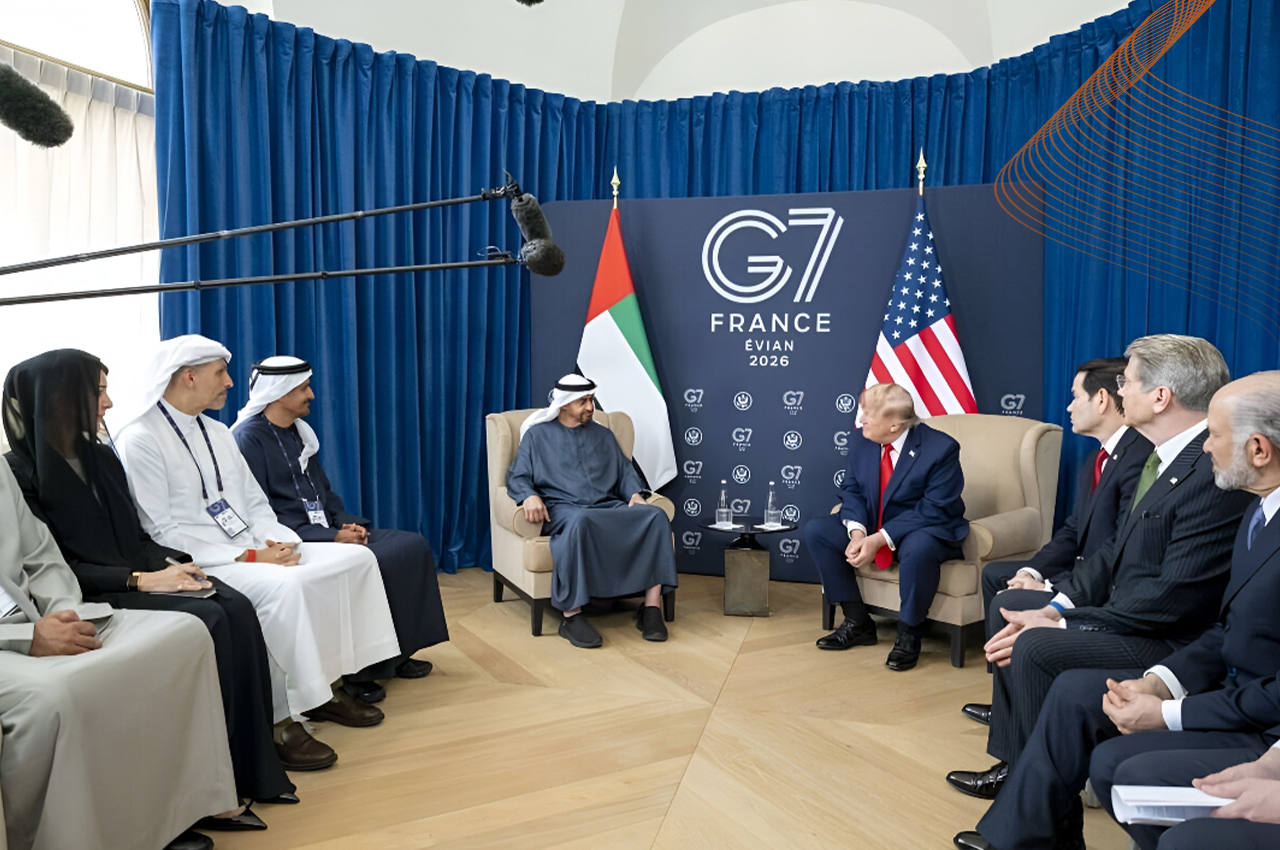
International trade is in the midst of an enormous change. With supply chains under unprecedented strain and geopolitical realignments transforming historic partnerships, the key question that everyone is asking is: What will global trade in 2026 look like?
This is beginning to be written in the Middle East. The UAE is sited ideally on the crossroads of east and west where it has quietly grown from a regional transit hub into one of the key players in today’s international trade. At the core of this change is a number of strategic relationships between the UAE and G7 countries (the USA, the UK, France, Germany, Japan, Italy and Canada), which are extremely calculated and deep.
The Emirates is reshaping the movement of goods, data and capital through significant investments in massive infrastructure developments, by taking the lead on AI governance and through its aggressive bilateral trade deals with the UAE. In this inside look at the UAE G7 economic alliances, we’ll explore the core of how they are shaping the future of global trade.
The East-West Economic Bridge: A link between the G7 and BRICS
A thing that is interesting in modern-day geopolitics is that the UAE is able to sit down at several tables simultaneously. The country has officially signed up for the BRICS grouping to strengthen its relationship with emerging economies, but has also kept and reinforced its long-standing ties with the G7 countries.
The UAE is neither forcing a choice between these two powerful economic groups nor is it imposing its will on them. It is acting as a neutral, hyper-connected diplomatic and logistical translator. As a literal and regulatory hub, Dubai or Abu Dhabi can provide a multi-national corporation with a convenient place to send capital, source manufacturing parts, and handle logistics efficiently between the G7 consumer markets and BRICS industrial centers.
This distinctive positioning has enabled the Emirates to become the key economic hub between East and West, maintaining uninterrupted global supply chains even when times are difficult in terms of geopolitical tension between the great powers.
In a fractured world, Supply Chain Resilience and Re-Shoring.
Once a corporate buzzword, “supply chain resilience” has become a national imperative. After years of manufacturing difficulties and changing trade policies, G7 countries have been actively seeking to re-shore and near-shore supply chains to support their economies.
The UAE has become the perfect ally in this endeavour. The country provides a very stable option for manufacturing, assembly and distribution for G7 countries via targeted UAE CEPA agreements (Comprehensive Economic Partnership Agreements).
What is UAE’s role in the diversification of the supply chain of G7?
Rather than requiring businesses to return to costly domestic soil, the UAE offers opportunities of “friend-shoring”. G7 companies can establish their advanced logistics operations in the specialized UAE free zones, enjoying world class infrastructure and without the threat of geopolitical shut down periods. This setup has a huge part to play in making G7 supply chains more resilient, in that it keeps the critical semiconductors, pharmaceuticals moving regardless of what is happening elsewhere.
Why are G7 Nations investing heavily in infrastructure in the UAE?
Take a walk through the huge logistics hubs of Jebel Ali Port or Khalifa Port, and you’ll see the physical results of billions of dollars of foreign investment. This is no accident, but part of the UAE’s long-term policy of diversifying its economy away from oil, which is paying off in huge returns.
What are the reasons for G7 countries investing heavily in the infrastructure of the UAE?
- Unmatched Scale and Efficiency: Unrivalled scale and efficiency G7 companies are based on predictive, fast logistics. UAE ports have deep water berths and automated terminals capable of loading and unloading cargo at a rate that is faster than most ports in the West.
- Capital Protection and FIPAs: Multi-billion-dollar investments also come with concrete legal protection under such agreements as the Foreign Investment Promotion and Protection Agreement (FIPA).
- A Launchpad to Emerging Markets: Investing in UAE infrastructure is not only about access to the Gulf but about having direct access to the emerging economies of East Africa, Central Asia and South Asia, which is the Launchpad to Emerging Markets.
The G7 rich countries are creating permanent, efficient hubs in the fastest-growing trade corridors on earth, through significant FDI in the UAE in the transport, logistics, warehousing and in green energy projects.
New Digital Trade Corridors and AI Governance.
Trade is not only for moving physical containers, it’s for moving data, IP and money quickly. The UAE is investing in groundbreaking UAE to digital trade corridors to make cross-border digital trade frictionless.
The importance of UAE-G7 cooperation in digital trade and AI governance.
Co-operation between UAE and UAE and UAE-G7 in technology is bringing a rapid pace of development. Digital trade is being normalised via massive joint ventures in the development of data centres, cloud computing platforms and blockchain customs clearance.
Moreover, with artificial intelligence taking the centre of supply chain logistics, the UAE and G7 partners are closely collaborating to jointly develop responsible artificial intelligence governance frameworks. They facilitate the alignment of requirements and facilitate secure, safe, and easy automated shipping, inventory prediction and digital payment at borders.
It is nothing new in the definition of Global Logistics Hubs.
Lines of the sea, air and twentieth century are being re-drawn. The UAE is experiencing notable change in the role of its strategic partnerships in creating logistics hubs around the world, driven by strong gains at home and bilateral agreements.
The UAE has gone beyond just being a fueling stop, with a combination of local infrastructure and G7 corporate knowledge. In today’s day and age, a product can be partly produced in Europe and arrive a few hours later at Al Maktoum International Airport to be delivered through automated logistics to a smart fulfillment centre, before being shipped out of Jebel Ali Port. This super-efficiency essentially sidesteps the conventional logistical problems, offering a faster and more stable way for global brands.
A future vision of the Middle East as the permanent trade hub.
The fate of the global trade routes which pass through the Middle East.
The demand for the trade corridors in the Middle East will further increase in the future. The place to pass through to get from Europe to Asia has become a place to pass through for international business.
The UAE has thus managed to guard itself against volatility in the wider world and become a part of the world’s most advanced economies by their polished alliances with the UAE G-7 economies. Non-oil trade diversification, pioneering digital corridors and offering unparalleled logistical resilience are shaping the future of global trade, while UAE is leading the way.
Below is some useful information to assist you in answering some of the most frequently asked questions.
Q1. What is CEPA and how will it benefit the UAE-G7 trade?
A1. Comprehensive Economic Partnership Agreement (CEPA) is a two-party trade pact that seeks to phase out or substantially cut tariffs, to eliminate or substantially reduce non-tariff barriers and to increase market access for services and investment. UAE CEPAs make it much more cost and time efficient for business activities across the Middle East and other regions for G7 countries.
Q2. What is the UAE doing to cultivate its relationship with the G7 and BRICs?
A2. Economic diplomacy is the philosophy that the UAE is built upon. The UAE is a neutral gateway, maintaining financial and logistical operations free and well connected. This allows for the free operation and trade of the G7 companies and BRICS economies in Emirati hubs, without being concerned with direct political matters.
Q3. Why is it essential for non-oil trade diversification for the future of the UAE?
A3. An economy runs on fossil fuels is vulnerable to fossil fuel price fluctuations and global transitioning to green energy. Diversification of the UAE’s economy into logistics, digital industries, tourism and manufacturing, provides long-term economic sustainability, making the UAE an attractive place for foreign investors.
Q4. How will AI be involved in the future of trade routes in the UAE?
A4. AI is employed to optimize shipping routes, real-time congestion management at ports, automation of customs documentation, and forecasting of supply chain disruptions. Heavy investment in AI infrastructure has transformed UAE’s ports and airports into some of the world’s most technologically advanced and efficient.
Stay up to date with global trade.
With the swift stream of international trade, sound, timely and penetrating analysis is essential. Whether it’s investor awareness of the opportunities these new corridors bring or a business’s need to meet new standards, being aware of these macro trends is crucial to success.
Check out Dubai Key Insights today for in-depth analysis, expert breakdowns and up to date information on the regulations, partnerships and economic trends impacting the UAE and the global market.