





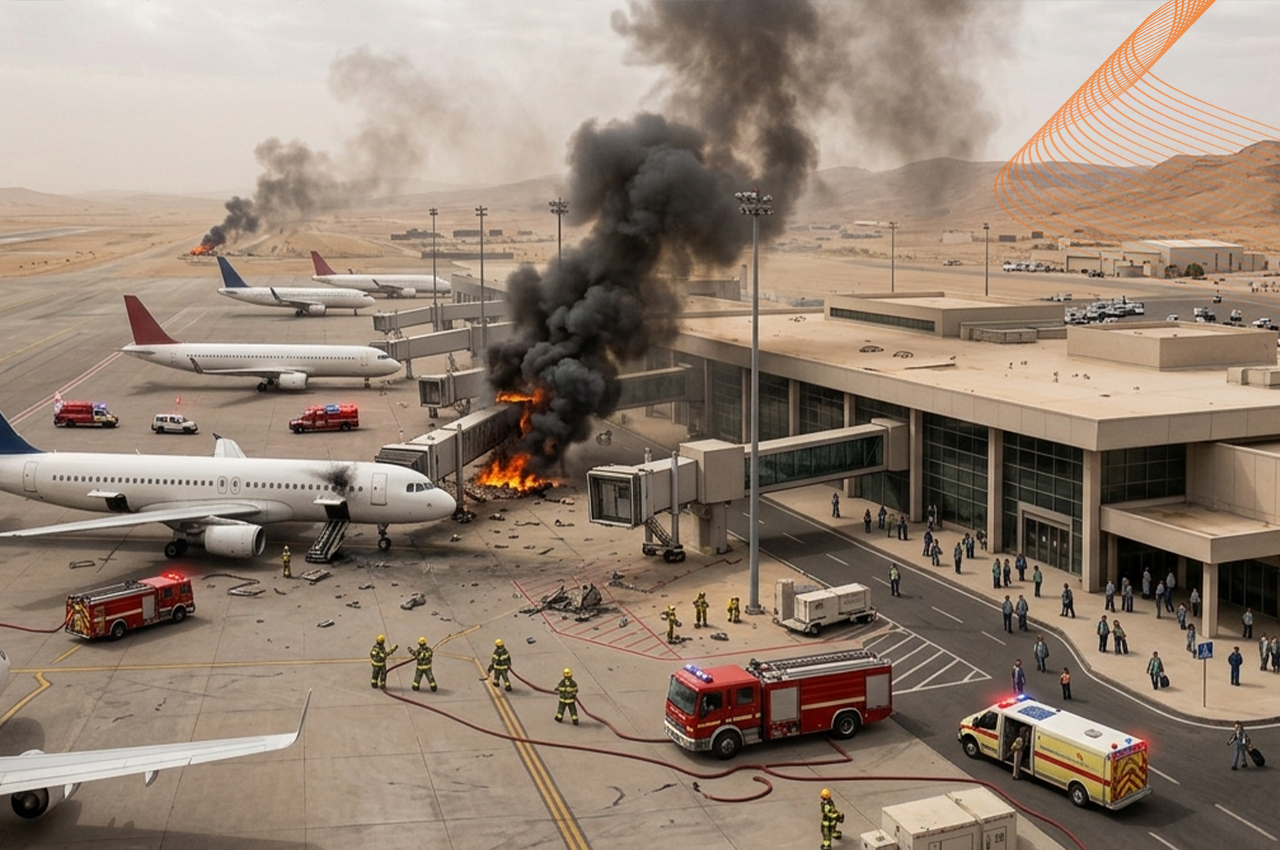
The security situation in the region was completely upended on Monday night, July 13, 2026, with the Iran-backed Houthi group firing ballistic missiles and unmanned aerial vehicles (UAVs) into Abha International Airport in Saudi Arabia’s southwest. This provocative move has effectively broken the thin veil of peace that had been prevailing in the region over the last few years and has put aviation authorities as well as international carriers into crisis mode. Newly in the wake of the incident, passengers across the Gulf are seeing flights cancelled and uncertainty in travel.
The initial days of the strike have resulted in a series of security alerts, not just in Saudi Arabia, but throughout the Middle East region. If you are planning trips or on one going, you need to have a grasp of the details of this escalation. In a public statement, the Houthi military spokesman, Yahya Saree, took the credit for the operation, which he described as a “direct retaliatory strike” against “Saudi military operations at Sanaa airport” earlier in the day. It’s an alarming example of how tensions in the region can escalate to a level that directly affects world civil-airway routes.
Understanding the Escalation and the Security Reality
The fundamental issue at stake in this situation is the complex interlacing of the hostilities which exist in the region. The Houthi leadership has warned explicitly international airlines of the dangers to airspace in Saudi Arabia, urging them to designate it as a dangerous zone until the blockade of Sanaa International Airport is lifted. The symbolic significance of a major commercial hub such as Abha International Airport being targeted is immense, yet Saudi defense systems went to work as expected and managed to intercept the incoming projectiles and save loss of life and from causing catastrophic damage to infrastructure. It impacts the southern Saudi carriers’ risk profiles in an extreme way and requires a fresh look.
The most direct impact on travelers is the disruption of known air corridors. Today’s attack on Abha Airport by the Houthis has altered the operating equation of regional airlines. At this level of security alerts, the aviation industry moves away from a normal scheduling mode to a reactive, risk-mitigation mindset. This may include flights that are not directly affected by the event becoming delayed or diverted due to the increased focus on air traffic control (ATC) operations for additional safety. It’s not just a matter of the airport that’s getting attacked, it’s when these things happen, the entire regional airspace is clouded with doubts.
Impact on UAE Flights and Regional Connectivity
The United Arab Emirates (UAE) is one of the key transit points for international travel, and the situation there has been significantly affected by these changes. The major regional airlines like flydubai and Air Arabia have had to cancel several flights to and from Abha International Airport. While the cancellations may be a logistical burden, they are also a matter of safety, given the ever-evolving threat picture in a world that can change in a matter of minutes. The ripple effect is strong, affecting business travellers, holidaymakers and families trying to get around with the hectic mid-July holiday season.
Additionally, the information about these disruptions is worrisome. According to aviation data sources such as FlightRadar24, a minimum of 10 flights were canceled on July 14, 2026, from Abha. International airlines and domestic Saudi airlines like Saudia and flyadeal. In many cases these cancellations are not limited to the flight, but are extended to Abha itself. A lot of travelers have connecting tickets and when the first part of the trip is affected, the whole trip is at risk. Airlines are in a dilemma as they try to reschedule thousands of affected passengers, and are also coordinating with security agencies to determine when it will be safe for normal operations in the region to resume.
The Question of Safety: Is It Safe to Fly to Saudi Arabia Right Now?
The big question on everyone’s mind right now is: Can I fly to Saudi Arabia now? The solution is complicated. The Kingdom’s main metros, such as Riyadh, Jeddah and Dammam, continue to be operational and safe for international travel, although the southwestern part of the Kingdom, including the region bordering on Yemen, is being monitored as a high-risk zone. International travel warnings from the big countries remain, advising their citizens to be very cautious.
One of the biggest issues travellers have is the unpredictable nature of security changes. The Saudi government has a strong defence network but due to the nature of drone and missile threats, airports continue to be a strategic target that has to be guarded in the ground. In case you are intending to travel to Saudi Arabia, you need to be extra mindful of your government’s official travel warning page. Such agencies deliver the most impartial, up-to-the-minute intelligence, which transcends the mainstream news stream. Also, for safety information, don’t take it from third party websites – check with your airline, who will be briefed on airspace safety protocols.
Strategic Navigation of Gulf Airspace and Travel Disruptions
As one of the world’s most important aviation hubs, Saudi Arabia is located at the intersection of Europe, Asia and Africa. This strategic position makes any incident, be it a small event such as the missile attack at Abha airport 2026, have worldwide repercussions. Sustained closure or a more restrictive flight path may force airlines to reroute aircraft if it becomes necessary because of the current situation. This means that the time of flight is longer, fuel consumption is higher, and operating costs are higher that ultimately end up in the hands of the consumer.
It is important for passengers to be ready for what it really means to be “dynamic travelers. This means that even if you have arrived at the airport, your flight may be cancelled. In this regard, travelers need to take a proactive approach. Your contact details (mobile telephone and email) should be completely correct in your airline’s booking system. Secondly, know the flexible rebooking options available. The major Gulf airlines are cognizant of the increased tension, and have eased change fees to accommodate the passengers who may have become uncomfortable with their travel to or from the affected areas and want to reschedule their travel. This flexibility will be your best defense against the unpredictability of the regional climate at the moment.
Regulatory Awareness: DGCA India and Beyond
Tensions in the region have made it a difficult place to travel, and it’s also crucial not to forget about the old-fashioned rules of flying. When travelling is disrupted, the frustration can be high and passengers will often behave in ways which they would not normally, such as taking photos or videos of sensitive areas of the Airport and posting these on social media platforms. One should also remember that regional aviation authorities in various regions have zero tolerance policies when it comes to unauthorized photography or video recording in high-security zones, for example the Directorate General of Civil Aviation (DGCA) in India, and other regional aviation authorities in the Middle East.
It could be extremely dangerous to try to film military activity or security at airports, or try to interrupt flights. These include severe financial fines, confiscation of equipment and, in severe cases, the passenger is added to a nationwide No-Fly List. The time of high alert is a time when security is put under a great deal of pressure and when it is very likely to enforce these rules more strictly. Keep yourself informed, remain calm and focus on your rights of travel, rather than taking photos of the scene. Your ultimate objective is to get to your destination safely and avoiding any friction with regard to security is a core component of that.
Comprehensive FAQs for Impacted Passengers
Q1. Are all flights to Saudi Arabia currently cancelled?
A1. No, flights to major cities such as Riyadh, Jeddah and Dammam are mostly continuing as normal. The disturbances are mainly affecting the southwestern sector, mainly in the Abha International Airport and its related air traffic.
Q2. If I am currently booked on a flight to Abha, what should I do?
A2. Don’t rely on an automatic notification. Verify your flight status often (usually every few hours) on the official airline website or mobile app. When a cancellation is made, promptly check if there are rebooking options available from the carrier, or reach out to their customer support line to explore your options, such as a full refund or rescheduling.
Q3. Is it safe to transit through Gulf airports like Dubai or Doha?
A3. Yes, it is still safe there and they’re working fine. Security concerns are confined to certain airspace around the conflict area. These regional events have not yet affected the key operations of large-scale international transit hubs in the UAE and Qatar.
Q4. How can I stay updated on the status of Gulf airspace?
A4. Not only do you track the flight you’re interested in, but you can use a trusted resource such as FlightRadar24 to see real-time route deviations. Also, keep a close eye on official instructions from civil aviation authorities of the countries you’re flying through or into as they will have the final say on whether the route is safe.
Q5. Will my travel insurance cover cancellations due to the Houthi missile attack?
A5. That will depend on the nature of your policy. Many regular travel insurance plans come equipped with “force majeure” or “geopolitical event” provisions. It would be wise to contact your insurance company today to find out if the current security situation activates your trip cancellation and/or trip delay coverage.
Stay Informed with Dubai Key Insights
By nature, the regional security situation is dynamic and uncertain. The morning could be different from the afternoon. Information is your most valuable resource as a traveller or resident of the Gulf. At Dubai Key Insights, we are committed to providing the most accurate and insightful analysis of the aviation and travel industry as it continues to progress. We cut through the confusion and give you the clarity you need to make smart and safe decisions as you travel through this complicated landscape.
Please bookmark our site and follow our exclusive alerts, so you never miss an important aviation safety or travel advisory from the Gulf. As the weather is unpredictable, we will be your constant source of information.
Be sure to subscribe to our newsletter to have updates on Gulf aviation and travel advisories sent to your inbox.