


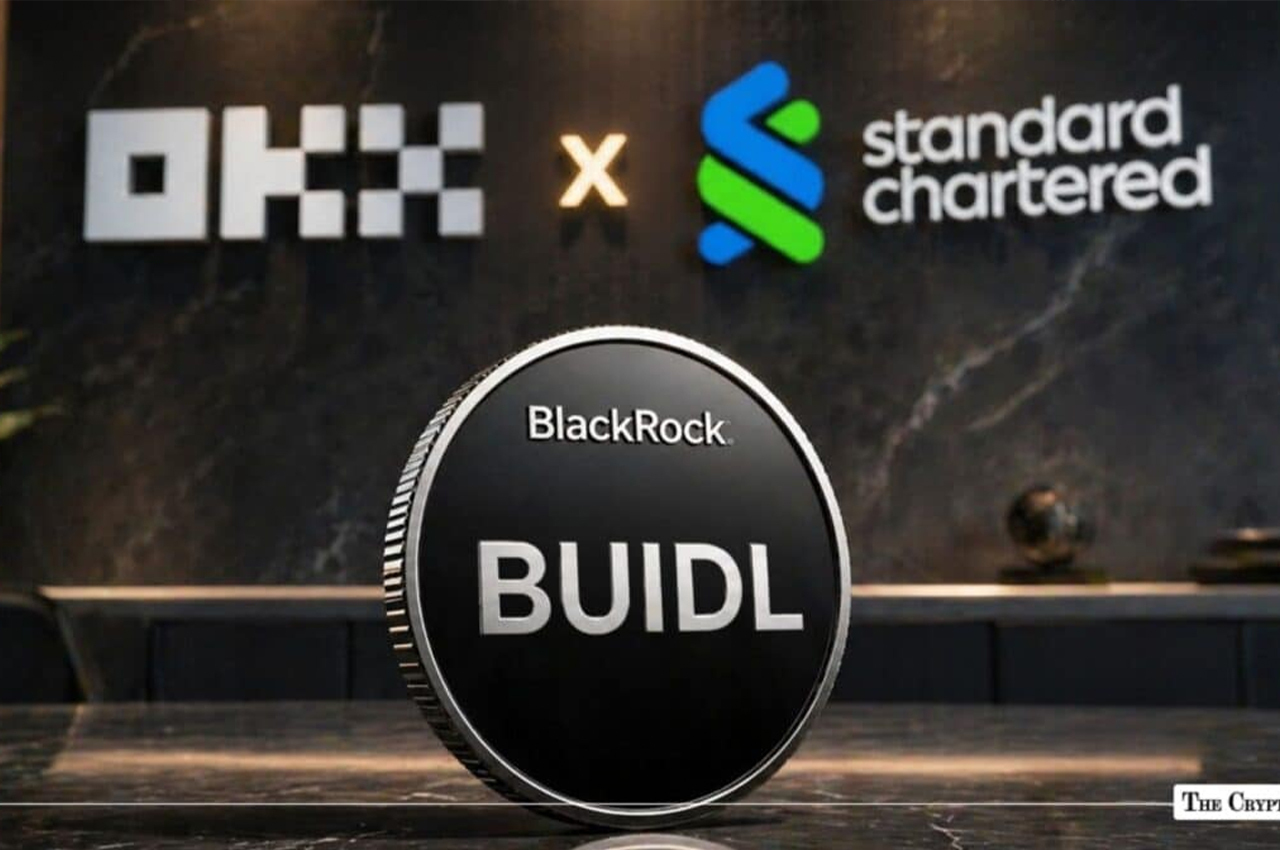
BlackRock, OKX, and Standard Chartered launch tokenised asset collateral framework, marking a major breakthrough in how traditional finance and digital assets converge. The initiative introduces a new model where tokenised real-world assets can be actively used in trading, signalling a shift in global financial infrastructure.
Key Development
Standard Chartered, BlackRock, and OKX have jointly launched a new collateral framework that allows institutional clients to use tokenised assets as trading collateral.
At the centre of the system is BlackRock’s tokenised US Treasury fund, known as BUIDL. This fund can now be used as yield-bearing collateral on OKX’s trading platform while being securely held in custody by Standard Chartered.
Key features of the framework include:
- Tokenised US Treasury assets used as collateral for trading
- Assets remain in regulated, off-exchange custody with Standard Chartered
- Continuous yield generation while assets are deployed
- Seamless integration between traditional finance and crypto markets
This marks the first time a globally systemically important bank has acted as custodian in such a tokenised collateral structure.
Why It Matters
The launch of this framework represents a significant shift in how capital is managed across financial markets.
For institutional investors:
- Capital can remain invested while being used for trading
- Reduced need to move assets between custodians and exchanges
- Improved capital efficiency and liquidity management
For the broader financial ecosystem:
- Bridges the gap between traditional finance and digital assets
- Introduces safer, regulated pathways into crypto markets
- Expands the use of tokenised real-world assets
This innovation could reshape how large institutions interact with blockchain-based markets, making them more accessible and aligned with existing financial standards.
Bigger Picture
The tokenised asset collateral framework reflects a rapidly growing trend towards the tokenisation of real-world assets.
Tokenisation allows traditional financial instruments such as government bonds to exist on blockchain networks, offering:
- Faster settlement times
- Greater transparency
- Programmable financial operations
The collaboration between BlackRock, Standard Chartered, and OKX highlights a broader industry shift where major financial institutions are embracing blockchain technology.
Globally, this trend is gaining momentum as:
- Asset managers explore tokenised funds
- Banks develop digital custody solutions
- Exchanges integrate traditional financial products
For Gulf markets, particularly the UAE, this development is highly relevant. Dubai has positioned itself as a hub for digital assets and fintech innovation, with platforms like OKX Middle East playing a key role in bridging global markets.
The framework also aligns with the UAE’s push towards becoming a leader in blockchain and digital finance, supporting institutional adoption and regulatory clarity.
What Happens Next
The success of this framework will depend on institutional adoption and regulatory acceptance.
Key developments to watch include:
- Uptake by institutional and VIP clients on OKX
- Expansion to other tokenised assets beyond US Treasuries
- Increased participation from global banks and asset managers
- Regulatory frameworks adapting to tokenised collateral models
Experts suggest that if adoption accelerates, tokenised assets could become a standard part of global financial infrastructure, transforming how collateral, trading, and liquidity are managed.
This could also pave the way for broader integration of blockchain technology into mainstream finance, moving beyond experimentation into large-scale implementation.
FAQs
What is the tokenised asset collateral framework?
It is a system that allows tokenised real-world assets, such as US Treasury funds, to be used as collateral for trading.
Who launched this framework?
Standard Chartered, BlackRock, and OKX jointly developed the framework.
What is BlackRock’s BUIDL fund?
It is a tokenised fund that invests in short-term US Treasury instruments and generates yield on blockchain.
Why is this important for finance?
It improves capital efficiency and bridges traditional finance with digital asset markets.
Could this impact the UAE and Gulf markets?
Yes, it supports the region’s growing role as a global hub for fintech, digital assets, and institutional innovation.