





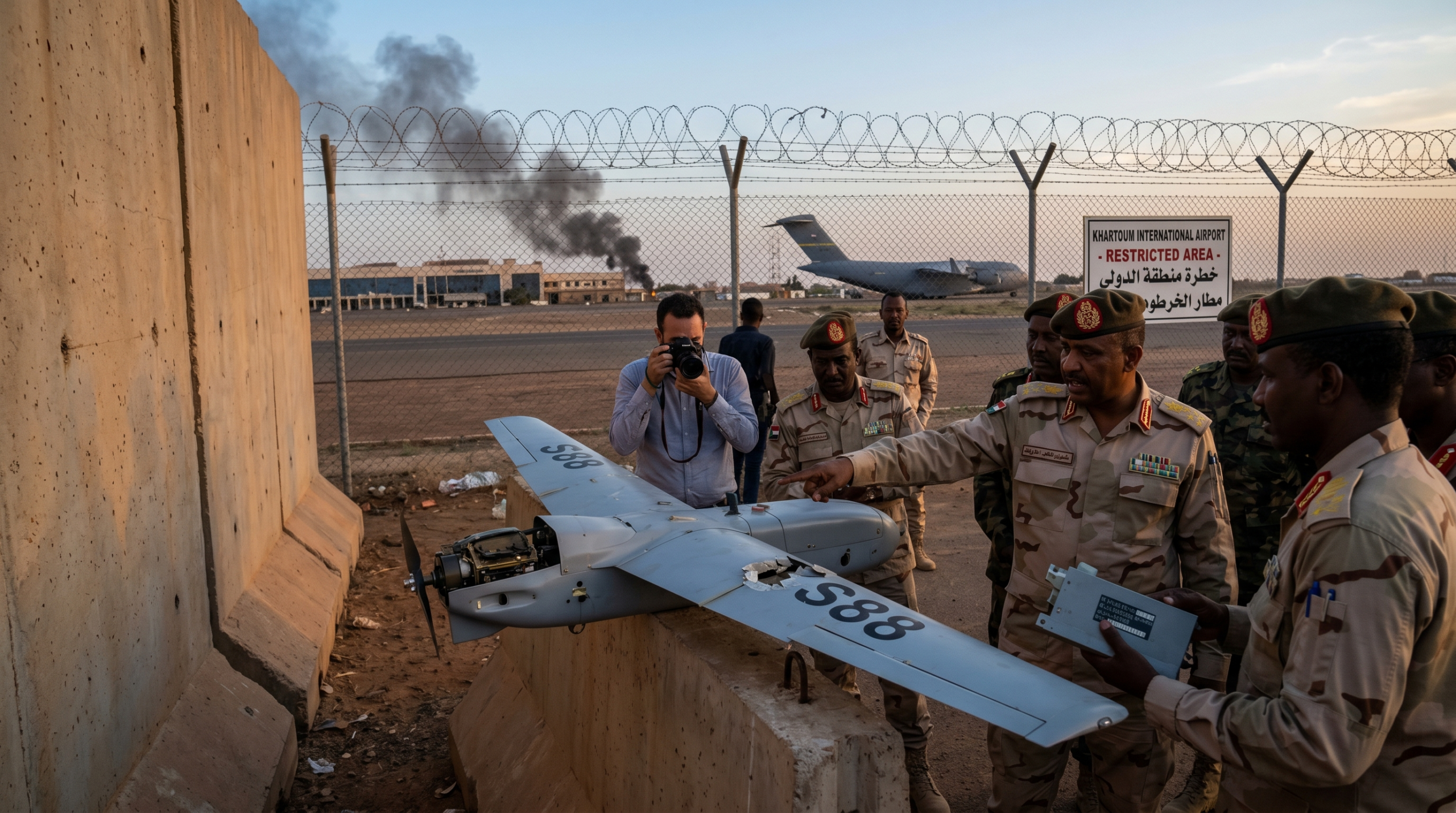
When you have been following the news of the Horn of Africa in the recent past, the headlines are becoming more and more strained. The latest flashpoint? A grave complaint by the Sudan government has caused shockwaves in the diplomatic quarters of the region. The United Arab Emirates (UAE) has officially been accused by Sudan of plotting a drone strike on Khartoum International Airport, a move that threatens to transform an already complex civil war into a full-scale regional conflict.
But what actually happened in the airport, and why is the role played by Ethiopia becoming a key component of the story? We can unravel the facts, the politics, and what it alludes to the future of Sudan.
What Happened at Khartoum Airport Today?
The silence of Khartoum was broken on May 4, 2026, when the buzz of unmanned aerial vehicles (UAVs) reached the city. As per the official statements by the Foreign Minister Mohieddin Salem, there were several drones that targeted the Khartoum International Airport, an airport that had just recently started seeing a resurgence of civilian activities and efforts to resume international flights.
Although Sudanese air defenses could still intercept some of the incoming threats, smoke was observed billowing out of the eastern side of the capital. Miraculously,y there were no immediate casualties or significant structural damage to the runway, and operations were restored within hours. But the psychological and political harm was already inflicted. This was not any other skirmish; this was a direct attack on a symbol of the Sudanese effort to reconstruct itself.
The Evidence: S88 Evidence: Evidence is an Emirati Property Drone Serial Number S88.
You may ask yourself how Sudan can be as certain as to who was behind the controls. In a high-tension press conference, Army Spokesman Brig. Gen. Asim Awad Abdelwahab presented what the Sudanese Armed Forces (SAF) refer to as “conclusive evidence.
The SAF revealed that they had downed a drone earlier in March 2026 near El-Obeid. After examining the debris, investigators purportedly discovered:
- Serial Number S88: A particular identifier that the SAF purports to connect the hardware to the military of the UAE.
- Flight Data Logs: Recovered co-ordinates of a flight path which had originated across the border.
- Technical Specs: Advanced technology that the SAF claims the Rapid Support Forces (RSF) would have been unable to operate without direct foreign experience.
These claims have long been denied by the UAE, which often claims that they are just so much political theater,r but in the case of Kharto, um, the physical evidence of Emirati property is a smoking gun that cannot be ignored.
Why does Sudan recall its Ambassador to Ethiopia?
Here the storyline becomes complex. The Sudan-UAE diplomatic crisis isn’t just a two-player game. Sudan has gone to the extreme of recalling its ambassador in Ethiopia to consult.
The reason? The SAF accuses the drones of not flying all the way down the Gulf. They instead allege that the Bahir Dar airport in Ethiopia has been turned into a launch site and control centre of these activities. In his judgment, Foreign Minister Salem was not subtle when he said that Ethiopia, a country that, according to him, should be a sister nation, was letting its land be used as a springboard to aggression.
The Bahir Dar Connection.
The SAF claims that at least three significant drone sorties since March 1 have been launched out of Bahir Dar. They suspect that the Ethiopian government is including logistical cover on UAE-operated drones to assist the Rapid Support Forces (RSF). Ethiopia has since responded and retaliated against these baseless accusations and instead accused Sudan of being a haven for TPLFLF mercenaries. This blame game of tit-for-tat is a typical indication of the local upsurge in the Sudan conflict.
The Horn of Africa Geopolitics: 2026 Update.
The Sudan 2026 update of the civil war in Sudan is a dark one. What began as a power struggle between Gen. Abdel Fattah al-Burhan (SAF) and the so-called “Hemedti” (RSF) in 2023 has now transformed into a proxy war.
The presence of the UAE and Ethiopia is indicative of an immense change in the geopolitics of the Horn of Africa. Sudan is also growing more and more dependent on allies such as Egypt and Eritrea to support it, and the RSF is also accused of receiving advanced drone technology, as well as funding, through the neighboring territories.
| Key Player | Stance/Allegation |
| Sudanese Armed Forces (SAF) | Accusing the UAE/Ethiopia of direct military intervention. |
| UAE | Denies involvement; claims to support humanitarian stability. |
| Ethiopia | Denies drone launches; accuses Sudan of violating its borders. |
| Egypt | Condemned the airport strike; supports Sudanese sovereignty. |
Is it Safe to fly to Khartoum International Airport?
The question, “Is it safe to fly to Khartoum International Airport? has the answer at the moment, as the majority of commercial travelers are saying no. Although there have been heroic acts of using drone warfare to resume international flights and bring ministries back to the capital, the frequent utilization of drone warfare in the African conflicts makes the airspace highly unpredictable.
The airport is still a major military target,t as whoever has got the tarmac has got the supply lines. The facility is probably going to continue being a high-risk zone unless a definite ceasefire is achieved.
The Human Cost of DronWarfarere.
There is more to the maps and the serial numbers; the situation on the ground is appalling. In Omdurman and Al Jazirah, there have been recent strikes that have led to the deaths of civilians, including five occupants of a bus just a few days ago. The high-tech drones used in densely populated areas are driving the death toll, already estimated at over 60,000, even higher.
The terrifying aspect of drone strikes being silent is an addition to the terror of the 13 million displaced people in this war. It is not merely a machine when a drone is spotted in the sky: it is an emblem of a struggle that has since transcended its boundaries.
Frequently Asked Questions (FAQs)
Q1. What is the main reason for the Sudan-UAEE diplomatic crisis?
A1. The main cause is that Sudan accuses the UAE of being involved in military and logistical assistance, namely advanced drones and weapons, to the Rapid Support Forces (RSF) to fight the Sudanese Army.
Q2. Has the UAE reacted to the allegations of a drone strike?
A2. The UAE has repeatedly denied that it is giving military assistance to either side in the Sudan conflict, claiming the allegations to be a cynical publicity gimmick and that they are solely interested in humanitarian assistance.
Q3. What is the contribution of the Bahir Dar airport to this?
A3. According to Sudanese military officials, the actual launch point of the drone attacks on Khartoum is the Bahir Dar airport in Ethiopia, which is allegedly hosting an Emirati-run control center.
Q4. How long has the Sudan civil war been going on?
A4. The war started in April 2023. It is now in its third year, becoming one of the worst humanitarian crises in the world.
Q5. Am I able to travel to Sudan at this point?
A5. Almost all foreign governments have strongly discouraged travel to Sudan because of active combat and drone attacks, not to mention the breakdown of most basic services.
Final Thoughts: A Region on the Brink.
The Sudan recalls ambassador 2026 move is more than just a diplomatic snub; it’s a warning. With the introduction of advanced drone technology and the engagement of countries that are neighbors, such as Ethiopia, the journey to the peace table appears to be incredibly steep.
To the Sudanese people, there is always hope that one day the international pressure will make these foreign actors sit down at the table. The skies over Khartoum are ato that point, a warning that a war is unwilling to keep within the confines of its battlefield.