



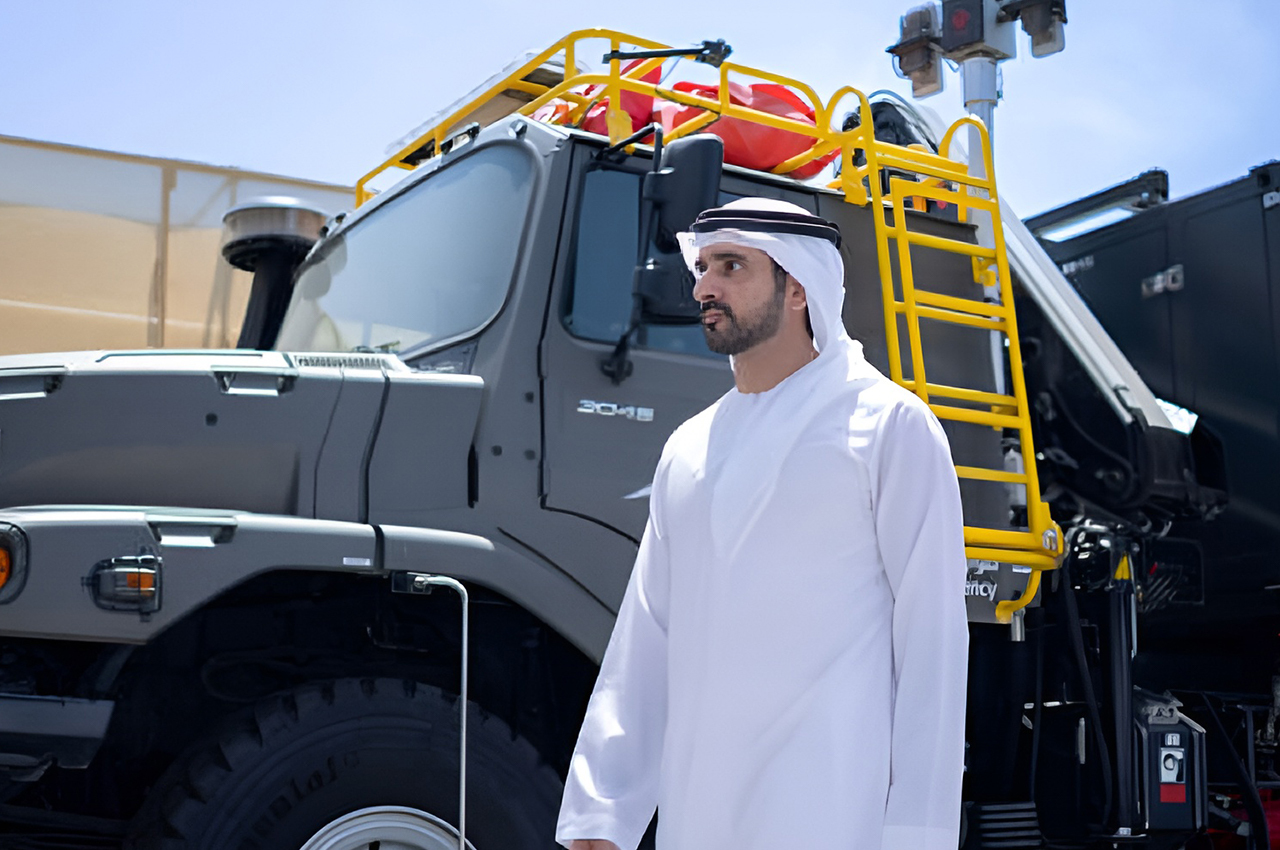
Sheikh Hamdan bin Mohammed bin Rashid Al Maktoum, Crown Prince of Dubai, recently conducted a high-level review of the emirate’s latest advancements in urban infrastructure and public safety. The tour highlighted the debut of a cutting-edge emergency response vehicle and the rollout of next-generation smart bus stations, both of which are central to Dubai’s goal of becoming the world’s most resilient and technologically advanced city.
Strategic Review
During his visit to the Roads and Transport Authority (RTA) and the Dubai Corporation for Ambulance Services, Sheikh Hamdan emphasized that integrating Artificial Intelligence (AI) into daily operations is no longer a luxury but a fundamental requirement for urban management. The new systems are designed to reduce emergency response times and enhance the commuter experience, supporting the Dubai 2040 Urban Master Plan‘s vision of a highly connected, “20-minute city.”
The review also underscored Dubai’s commitment to sustainable mobility. By leveraging smart data to manage traffic and public transport, the city is significantly reducing its carbon footprint while increasing operational efficiency. Sheikh Hamdan noted that these projects reflect the leadership’s dedication to providing world-class services that prioritize the well-being and safety of every resident and visitor in the emirate.
The New Emergency Response Vehicle
The centerpiece of the public safety review was a custom-engineered, multi-purpose emergency vehicle. This “mobile command center” is designed to navigate Dubai’s unique urban landscape with unprecedented speed and technical capability. Key features include:
- Integrated Telemedicine: Real-time 5G connectivity allows paramedics to consult with hospital specialists via high-definition video during transit.
- AI Dispatching: The vehicle uses predictive algorithms to anticipate traffic patterns, ensuring the fastest possible route to an incident.
- Compact Agility: Despite its heavy-duty equipment, the vehicle’s chassis is designed for maneuverability in high-density areas like Downtown Dubai and Dubai Marina.
- Rapid-Response Gear: Equipped with the latest in cardiac support and trauma care technology, functioning as a “mini-ER” on wheels.
Next-Generation Smart Bus Stations
Sheikh Hamdan also inspected the newly inaugurated smart bus stations, which represent a radical departure from traditional transit stops. These stations are built to provide a seamless, tech-driven environment for the city’s growing number of public transport users.
The stations feature climate-controlled interiors powered by integrated solar panels, ensuring sustainability while offering relief from the summer heat. Inside, passengers have access to real-time interactive screens that provide live updates on bus locations, estimated arrival times, and multi-modal route planning. These hubs also offer free high-speed Wi-Fi and integrated retail kiosks, transforming a simple wait into a productive and comfortable experience.
Why It Matters
These developments are critical to maintaining Dubai’s status as a global leader in infrastructure. As the city’s population continues to grow, the pressure on emergency services and public transport networks increases. By investing in smart vehicles and stations, the government is “future-proofing” the city.
From an economic perspective, world-class transit and safety systems are primary magnets for foreign investment and international talent. Investors look for cities that offer high levels of stability and efficiency. For the average resident, these innovations translate into shorter commutes, safer streets, and the peace of mind that comes with knowing the world’s most advanced emergency care is just minutes away.
Bigger Picture
This review is part of a broader push to transform Dubai into a “Smart City” in the truest sense—where data informs every decision. The integration of the emergency vehicle with the smart bus station network suggests a future where all urban elements communicate with each other. For example, smart stations could eventually be used as emergency beacons or automated external defibrillator (AED) points, linked directly to the new response vehicles.
In the regional context, Dubai remains the benchmark for the Middle East’s smart infrastructure. As Saudi Arabia and Qatar embark on their own massive urban projects, Dubai continues to innovate at a pace that keeps it at the forefront of the global stage. These projects reinforce the UAE’s position as a hub for innovation, safety, and a high quality of life.
What Happens Next
Following Sheikh Hamdan’s review, the RTA and Dubai Ambulance are expected to begin a phased rollout of these technologies across the emirate. Residents will start seeing the new emergency vehicles in high-traffic zones over the coming months, while additional smart bus stations are slated for construction in key residential and business districts.
Furthermore, the data collected from these initial units will be used to refine future designs. The government plans to eventually integrate these systems with the upcoming Dubai Metro Blue and Gold Lines, creating a unified, AI-managed transport and safety grid. This evolution ensures that as Dubai grows larger, it also grows smarter and safer for everyone.
FAQs
What makes the new emergency vehicle “smart”?
It utilizes 5G-enabled telemedicine and AI-driven route optimization to provide hospital-level care while navigating the fastest possible path to the patient.
Are the new bus stations environmentally friendly?
Yes, they feature solar-powered systems for lighting and interactive screens, contributing to Dubai’s green energy goals.
Where will the new smart bus stations be located?
Initial stations are being deployed in high-density areas, with plans to cover all major transit hubs across the emirate by 2030.
Can passengers use Wi-Fi at these stations?
Yes, all next-generation smart stations provide free, high-speed Wi-Fi to commuters as part of the “Digital Dubai” initiative.
How does this affect emergency response times?
The combination of AI route planning and specialized vehicle design is expected to significantly lower response times, particularly in congested urban areas.